Full Contour Zirconia vs. E.max Crowns: How to Choose the Right Material for Every Case
When a crown case lands on your schedule, the choice between full contour zirconia and e.max lithium disilicate often comes down to a single question: does this tooth need strength or translucency? A second molar under heavy occlusal load and a maxillary lateral in the smile zone demand fundamentally different materials, and defaulting to the same one for both invites fractures, remakes, or esthetic compromises.
Full contour zirconia and e.max are the two most commonly prescribed all-ceramic crown materials in restorative dentistry today. Both are versatile, well-documented, and capable of excellent results. But they are not interchangeable, and choosing the wrong one costs you and your patient time and trust.
This guide breaks down the clinical differences between these two materials so you can match the right crown to every case with confidence, not habit.
The Short Version
Choose full contour zirconia
for posterior molars, bruxism patients, short clinical crowns, and cases where conventional cementation is preferred.
Choose e.max
for anterior restorations, esthetic-zone implant crowns, and cases where adhesive bonding and translucency are priorities.
Material Fundamentals: What Each Crown Is Made Of
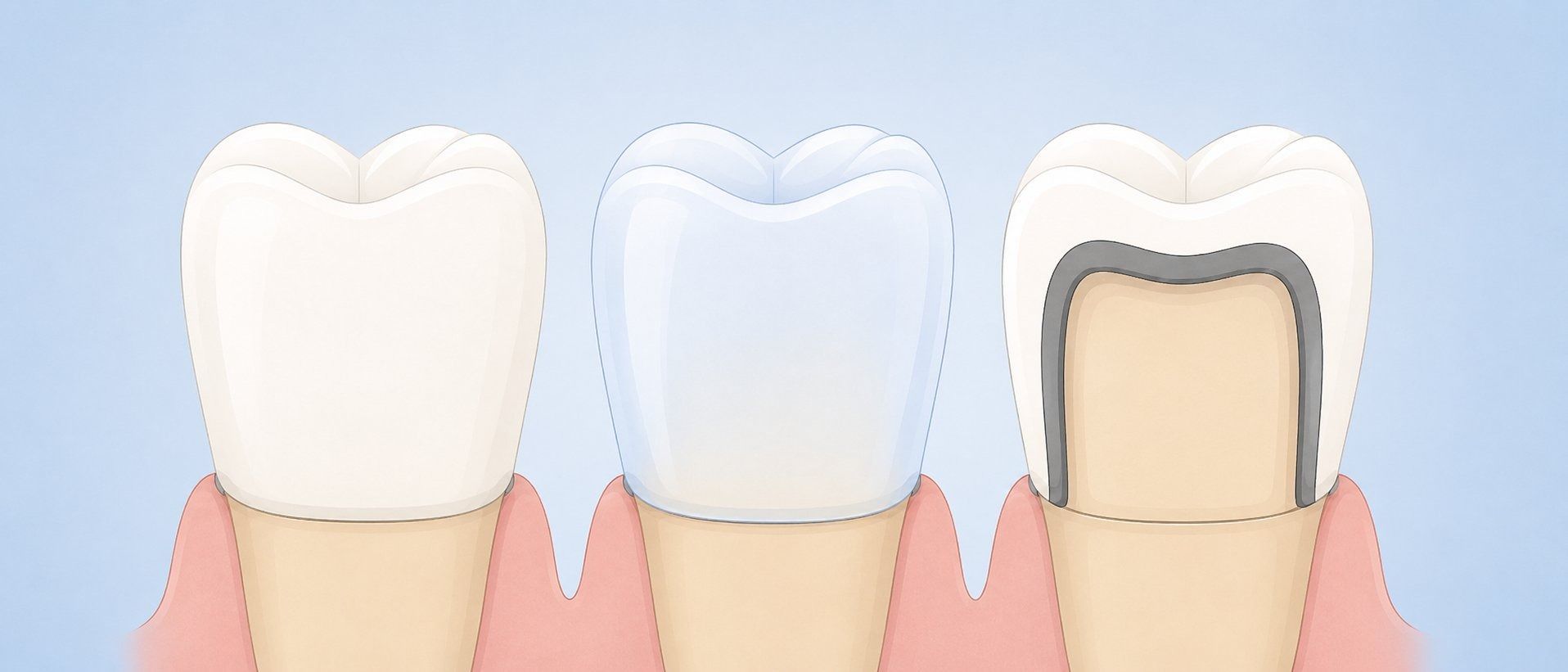
Full contour zirconia crowns are monolithic restorations milled from yttria-stabilized tetragonal zirconia polycrystal (Y-TZP). The most common formulation for posterior load-bearing crowns is 3Y-TZP, which contains 3 mol% yttria (Y 2 O 3 ). Because the crown is a single block of zirconia with no layered porcelain, there is no veneer interface to chip or delaminate. That monolithic design is the material's defining advantage in high-stress situations.
IPS e.max CAD, manufactured by Ivoclar, is a lithium disilicate glass-ceramic. It arrives as a partially crystallized “blue” block containing approximately 40% lithium metasilicate crystals (per Ivoclar IPS e.max CAD Scientific Documentation §1.2.4), is milled via CAD/CAM, and then undergoes a crystallization firing at approximately 840 to 850°C that converts the microstructure to its final lithium disilicate form, developing the material's final strength, shade, and translucency. The glass-ceramic microstructure gives e.max its optical properties: light passes through the material in a way that closely mimics natural enamel and dentin.
Why This Distinction Matters Clinically
Zirconia is polycrystalline with no glass phase. It resists crack propagation through a mechanism called transformation toughening: stress at a crack tip causes the crystal structure to shift from tetragonal to monoclinic, creating a compressive zone that arrests the crack. E.max, by contrast, is a glass-ceramic. It achieves strength through a dense network of interlocking lithium disilicate crystals but still has a glassy matrix. That matrix is what makes e.max more translucent and more etchable for adhesive bonding, but also more susceptible to fracture under heavy occlusal forces.
Flexural Strength and Fracture Resistance: The Numbers
Flexural strength is the single most referenced mechanical property when comparing crown materials, and the gap between these two is significant.
Conventional 3Y-TZP monolithic zirconia delivers flexural strength values typically in the range of 900 to 1,200 MPa, as seen in monolayer high-strength zirconia products such as Zirlux FC2 (1,100 MPa, approximately 5.35 wt% Y 2 O 3 ; meets the ISO 6872 Class 5 flexural-strength threshold of ≥800 MPa) and Kuraray Noritake's KATANA HT monolithic discs (1,125 MPa), which Kuraray classifies by ISO 6872 rather than by the Tosoh 3Y/4Y/5Y convention. Glidewell publishes BruxZir Full-Strength at greater than 1,000 MPa in its official specifications, with authorized-lab materials historically citing approximately 1,150 MPa.
Fracture toughness runs approximately 4 to 6 MPa·m 1/2 when measured by validated direct methods such as chevron-notch beam, surface-crack-in-flexure, modified indentation, and quantitative fractography (Kailer & Stephan, 2016; Begand et al., 2022; Jodha et al., 2025). Higher-translucency formulations trade some strength for improved optics. Per the 2026 Bernauer systematic review of translucent zirconia, 4Y-PSZ materials show a pooled mean flexural strength of 803 ± 233 MPa and 5Y-PSZ materials a pooled mean of 570 ± 116 MPa across 78 laboratory studies. Multi-layer zirconia blanks use different architectures. Strength-gradient products such as IPS e.max ZirCAD Prime combine 3Y-TZP in the dentin zone with 5Y-PSZ in the incisal zone, with an intermediate transition layer per Inokoshi et al. (2023). Katana YML combines three different yttria compositions across four layers with a published flexural-strength gradient from 1,100 MPa at the base to 750 MPa at the enamel; independent characterization (Inokoshi et al., 2023) places the composition span at approximately 4 to 5 mol% yttria, though Kuraray does not publish per-layer mol% labels. Glidewell's BruxZir Esthetic, by contrast, is a monolithic pre-shaded zirconia that Glidewell specifies with a single 4Y composition (4.6 to 4.9 mol% Y 2 O 3 ) at 870 MPa, with no per-layer gradient values published. Know which architecture you're prescribing before citing 3Y-TZP strength for the cervical region.
IPS e.max CAD has a mean biaxial flexural strength of 530 MPa, per Ivoclar's internal R&D testing at Schaan over more than 10 years. For fracture toughness, Ivoclar cites 2.11 MPa·m 1/2 from a 2016 AADR/CADR poster by Hill and Tysowsky; peer-reviewed sources report values in the range of 2.0 to 2.5 MPa·m 1/2 for lithium disilicate.
In practical terms, 3Y-TZP zirconia is approximately two times as strong as lithium disilicate and has roughly two to three times the fracture toughness, depending on the specific grades and measurement methods compared. That mechanical advantage makes full contour zirconia the default choice when occlusal forces are the primary concern: bruxism patients, posterior molars, short clinical crowns, and cases where adhesive bonding is impractical.
E.max's 530 MPa is not weak, though. It exceeds the ISO 6872:2024 Class 3 threshold of 300 MPa for single-unit and three-unit non-molar prostheses (adhesive or non-adhesive cementation) and far surpasses the 100 MPa Class 2 threshold for single-unit anterior or posterior prostheses that are adhesively cemented. For single-unit crowns and short-span bridges up to the second premolar, that strength is clinically proven. Ivoclar's internal Kaplan-Meier analyses (R&D Ivoclar, Schaan) report a 97.2% technical survival rate for monolithic IPS e.max CAD posterior crowns over 10 years and 95.2% over up to 15 years, using technical endpoints reported by Ivoclar as fracture and chipping (Scientific Report Vol. 04/2025, p. 7). Independent peer-reviewed data confirm strong long-term clinical performance: Rauch et al. (2018) reported an 83.5% Kaplan-Meier survival rate and a 71.0% complication-free rate at 10 years. Survival-defining failures in the 2018 cohort included one crown fracture, an abutment fracture, one severe endodontic problem, a root fracture, and a replacement of one crown caused by a carious lesion, while separately reported complications (retention loss of one crown, two carious lesions, and a change in sensibility perception of two abutment teeth) were captured in the complication-free metric. The 15-year follow-up (Rauch et al., 2023) reported 80.1% survival.
Esthetics and Translucency: Where E.max Leads
If strength is zirconia’s calling card, translucency is where lithium disilicate earns its reputation. E.max’s glass-ceramic structure transmits light in a way that polycrystalline zirconia cannot fully replicate, producing depth, vitality, and a natural interplay of color that blends seamlessly with adjacent teeth.
IPS e.max CAD is available in four translucency levels (HT, MT, LT, and MO), plus an Impulse version (Opal 1 and Opal 2) specified by Ivoclar for veneers with pronounced opalescent effect, across a comprehensive range of A-D and bleach shades. For anterior restorations where shade matching, incisal translucency, and surface characterization are critical, e.max remains the benchmark all-ceramic option.
Zirconia manufacturers have made real progress on esthetics. Multi-layer zirconia blanks now incorporate gradient translucency from cervical to incisal, and 5Y formulations offer significantly better light transmission than the opaque 3Y materials of a decade ago. For many premolar and even some anterior cases, these newer zirconia options deliver acceptable esthetics. But for a maxillary central incisor adjacent to a natural tooth, or any case where the margin is visible and the tissue is thin, e.max still provides the most predictable esthetic result.
Clinical Indications: Matching Material to Case
When Full Contour Zirconia Is the Stronger Choice
Posterior molars under heavy occlusal load. Patients with documented or suspected bruxism. Short clinical crowns with limited retention form. Cases where subgingival margins make isolation for adhesive bonding difficult. Implant-supported posterior crowns where retrievability takes priority over translucency. Long-span fixed partial dentures. Any situation where mechanical durability outweighs esthetic nuance.
Anterior crowns where shade matching is paramount. Veneers, inlays, and onlays that benefit from adhesive bonding. Single-unit implant crowns in the esthetic zone. Minimally invasive preparations where 1.0 mm of clearance is sufficient. Cases where the adjacent teeth have high translucency and a zirconia restoration would appear opaque by comparison.
At Summit-Horizon Dental Lab, our full contour zirconia restorations are milled from premium 3Y-TZP material, with shade, contour, and translucency customized to each case. For patients with parafunctional habits, we often recommend monolithic zirconia combined with simplified occlusal anatomy: broad, shallow contacts that distribute forces more evenly and reduce the risk of point-loading failures.
Summit-Horizon fabricates e.max restorations for select anterior cases and single-unit implant crowns, leveraging the material’s esthetic properties where they matter most. When a case falls in the gray area between materials, our team can review your scans and recommend the option most likely to deliver a predictable, long-lasting result.
Preparation Design: What Each Material Requires
Prep design differences between these materials are modest but clinically meaningful.
Full contour zirconia crowns can often be placed with reduced occlusal clearance depending on the formulation. Some high-strength 3Y-TZP products permit a 0.5 mm minimum wall thickness; most manufacturers specify 0.7 to 1.0 mm; and clinical guidance typically favors 1.0 to 1.5 mm for predictable long-term results. That conservative prep range preserves more tooth structure, which is a significant advantage on posterior teeth with limited supragingival height. Margins can be a chamfer or a rounded shoulder. Because zirconia can be conventionally cemented, subgingival margins in areas difficult to isolate are manageable.
E.max crowns require approximately 1.5 mm of occlusal/cusp reduction for posterior cases per Ivoclar's IPS e.max CAD chairside IFU, with the IPS e.max Clinical Guide citing approximately 2 mm for the crown third, giving a practical target of 1.5 to 2.0 mm. Ivoclar does not publish guidance to prepare deeper in heavy-occlusion cases. Ivoclar's contraindication language varies by IFU edition: the IPS e.max Clinical Guide and current Labside Monolithic Solutions IFU list “bruxism,” while some earlier IPS e.max CAD chairside IFU editions used the broader term “parafunctions.” Ivoclar approves a 1.0 mm minimum material thickness for minimally invasive crowns in the anterior and posterior regions when adhesive cementation is used. The material performs best with a uniform reduction that avoids thin spots, particularly in the incisal third. Adhesive cementation is strongly recommended to maximize fracture resistance, which means reliable isolation during bonding. Margin design follows standard all-ceramic protocols: a smooth, continuous chamfer or light shoulder.
For a deeper dive into preparation specifications across all major crown materials, see Summit-Horizon’s Crown and Bridge Material Guide.
Full Contour Zirconia vs. E.max: Side-by-Side Comparison
| Factor | Full Contour Zirconia (3Y-TZP) | E.max (Lithium Disilicate) |
|---|---|---|
| Flexural strength | 900–1,200 MPa | 530 MPa |
| Fracture toughness | 4–6 MPa·m 1/2 | 2.11 MPa·m 1/2 |
| Translucency / esthetics | Good (improving with 4Y/5Y); less natural than glass-ceramic | Excellent; closest to natural enamel among high-strength ceramics |
| Best zone | Posterior, high-load, bruxism cases | Anterior, esthetic zone, single-unit implants |
| Minimum occlusal reduction | 0.5–1.0 mm (manufacturer-dependent) | 1.5–2.0 mm posterior per Ivoclar Clinical Guide; 1.0 mm minimum for bonded anterior or posterior |
| Cementation | Conventional or self-adhesive; adhesive optional | Adhesive bonding recommended for optimal performance |
| Chipping risk | Minimal (monolithic, no veneer layer) | Low for monolithic; higher if layered or under-supported |
| Ideal patient profile | Bruxers, heavy occluders, limited crown height | Esthetic-priority patients, adequate clearance, isolatable margins |
| Long-span bridge suitability | Yes, including molar spans | Limited to 3-unit FPDs up to second premolar |
| 10-year clinical survival | Well-documented; varies by study and formulation | Ivoclar: 97.2% technical at 10 yr, 95.2% at 15 yr; Rauch: 83.5% overall at 10 yr, 80.1% at 15 yr |
Frequently Asked Questions
Can e.max be used on posterior molars?
Yes, with appropriate case selection. E.max monolithic crowns have strong clinical data supporting their use on premolars and first molars when occlusal forces are within a normal range and adequate reduction is achieved. Ivoclar's contraindication language varies by IFU edition: the IPS e.max Clinical Guide and current Labside Monolithic Solutions IFU list “bruxism,” while some earlier IPS e.max CAD chairside IFU editions used the broader term “parafunctions.” Many clinicians additionally avoid e.max on second and third molars in heavy grinders where full contour zirconia provides a wider safety margin.
Is zirconia too opaque for premolars?
Not necessarily. Multi-layer and 4Y/5Y zirconia formulations have significantly improved translucency compared to earlier generations. For upper premolars in the smile line, these newer materials can produce acceptable esthetic outcomes. If the premolar is highly visible and adjacent to natural teeth with significant translucency, e.max may still be the better option. Your lab can help you weigh the tradeoff.
Does cementation method affect which material I should choose?
It can. E.max achieves its best fracture resistance with adhesive cementation, which requires good isolation and adds chairside time. Zirconia performs well with conventional or self-adhesive cements, making it more forgiving in subgingival or difficult-to-isolate situations. If you know bonding conditions will be compromised, zirconia is the safer path.
What about antagonist wear with zirconia crowns?
Early concerns about zirconia wearing opposing enamel more aggressively than other ceramics have been addressed by polishing protocols. Research shows that highly polished monolithic zirconia produces enamel wear comparable to lithium disilicate. The key is a smooth, well-polished surface: glazed zirconia without subsequent polishing can be rougher and more abrasive. At Summit-Horizon, our finishing protocols prioritize a polished occlusal surface to minimize antagonist wear.
How Summit-Horizon Helps You Choose
Material selection is one of the most consequential decisions in restorative case planning, and it does not have to be a solo exercise. Summit-Horizon’s team, led by Michael Wandling, MBA, Master CDT, reviews every case with an eye toward material fit, occlusal design, and long-term predictability. That kind of collaboration is what separates a vendor from a true clinical collaborator, and it is central to choosing the right lab partner.
When you submit a case, we evaluate the scan data, the opposing arch, the occlusal scheme, and any clinical notes you provide. If we see indicators that suggest one material over the other, such as wear patterns consistent with parafunction, limited occlusal clearance, or high esthetic demand, we will flag it and discuss options before fabrication begins. That collaboration is built into our process, not bolted on as an afterthought.
Need help choosing between full contour zirconia and e.max for your next case? Contact Summit-Horizon to discuss material options with our team. You can also submit a case directly, and we will review the clinical situation, flag any concerns, and recommend the material path most likely to deliver a confident, first-time seat.
References
Share Post
Search Post
Recent Insights