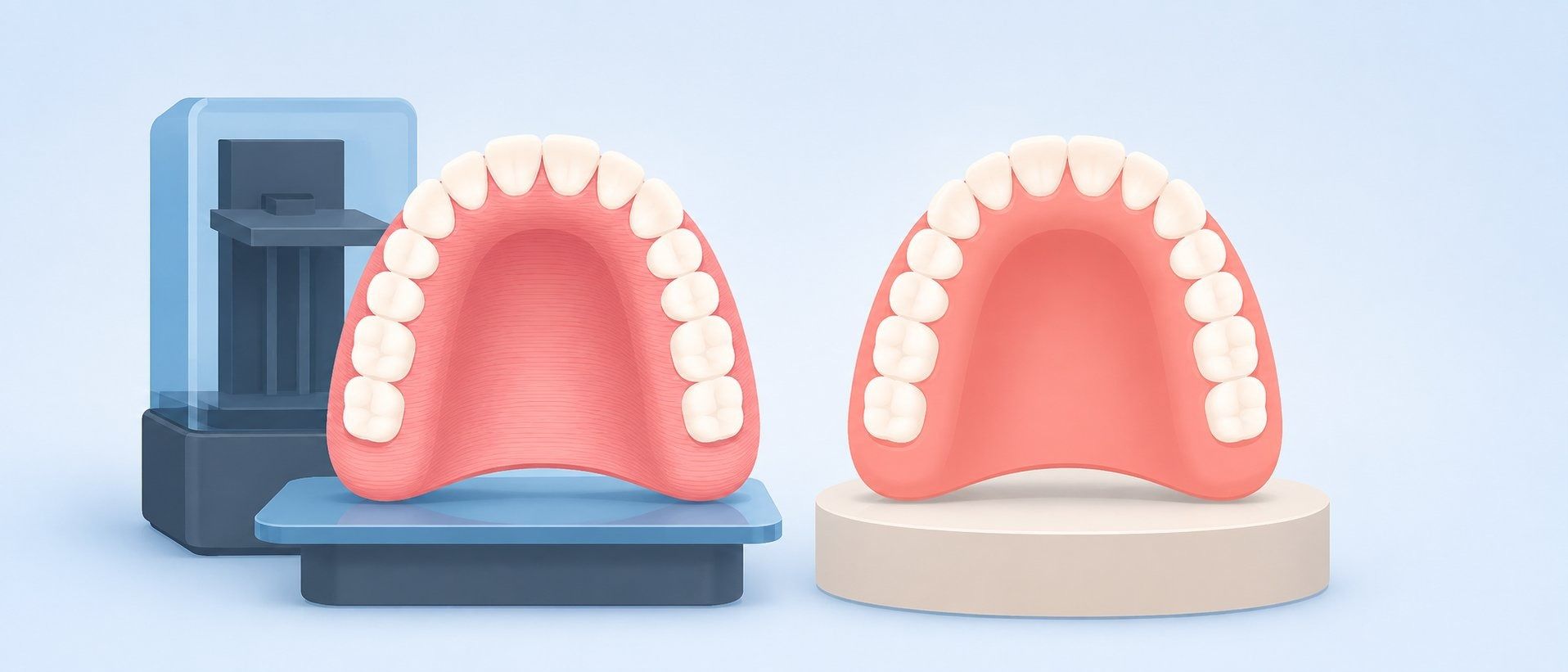

Hard Occlusal Guards vs. Dual-Layer Guards: Which One Is Right for Your Bruxism Patient?
Choosing between hard occlusal guards and dual-layer guards is one of the more routine prescribing decisions you'll face once a patient's bruxism is confirmed. The signs are familiar: shiny wear facets, a cracked marginal ridge, maybe a fractured restoration that doesn't square with the patient's age or reported habits. What's less obvious is which appliance design actually serves the case, because both protect teeth by distributing force and neither reliably stops the grinding itself.
This post compares hard and dual-layer occlusal guards across four practical dimensions: how each is built, what the evidence says about performance, how comfort and durability factor into the choice, and where each is indicated. A side-by-side comparison table and a clinical FAQ round it out, with a note on how digital fabrication tightens the fit.
The Short Version Choose a hard occlusal guard for heavy, established bruxers, cases needing durable long-term protection, and situations that call for precise occlusal control.
Choose a dual-layer guard for patients who can't tolerate a rigid appliance, where comfort and retention drive wear-time compliance.
Either way: a guard protects by distributing force. It does not cure bruxism, and no appliance reliably switches off the grinding.
What Each Guard Actually Is
Before weighing the tradeoffs, it helps to be precise about what separates these two appliances, because the difference is structural, not cosmetic.
Hard Occlusal Guards
A hard occlusal guard is a single rigid layer, fabricated either from processed (heat-cured) hard acrylic or from a hard thermoplastic that's thermoformed over a model. It covers the full arch and presents a hard, wear-resistant occlusal surface that holds an adjustment. Equilibrate the guard or refine the contacts and those changes stay put, which matters wherever occlusal control is part of the goal. Summit-Horizon fabricates hard occlusal guards from digital impressions, and the rigidity that makes them durable is the same property that lets them keep a precise occlusal scheme over time.
One caveat to set with patients: a rigid appliance worn continuously over the long term can contribute to occlusal changes, so periodic follow-up to check the bite and the fit is part of responsible use.
Dual-Layer (Hard/Soft) Guards
A dual-layer guard, sometimes called a hard/soft or laminate appliance, is built from two bonded materials. The inner layer, on the tissue side, is a soft thermoplastic that cushions against the teeth and grips for retention. On the occlusal side, the outer layer is hard and adjustable, giving the patient a firm biting surface rather than a fully soft one. Manufacturers position this construction as the comfort of a soft guard with the function of a hard one. Summit-Horizon's dual-layer (hard/soft) occlusal guards follow that laminate design, with the soft interface intended to improve initial tolerance and seating.
How They Perform: What the Evidence Shows
This is where product literature and clinical data tend to part ways, and where the actual evidence earns its keep.
The foundational comparison is Okeson's 1987 study, which recorded nocturnal masseter and temporalis activity in ten bruxers wearing first a hard and then a soft splint. In that study, the hard splint significantly reduced muscle activity in eight of the ten participants. Its soft counterpart did close to the reverse: it reduced activity in only one participant and significantly increased it in five. That result is the origin of the long-standing caution against fully soft night guards for grinders. It is also a small, decades-old study, best read as a foundational signal rather than a settled rule.
Larger syntheses temper the picture further. A 2024 systematic review and meta-analysis in the European Journal of Oral Sciences found that neither soft nor hard appliances meaningfully changed masseter and temporalis activity or bite force in sleep bruxers, with the certainty of evidence rated very low to low. Findings from a 2024 BMC Oral Health systematic review pointed in a similar direction: among the splint types studied, adjustable full-occlusion biofeedback designs showed the most effect on bruxism episodes, while the influence of conventional soft and hard splints on EMG activity varied from study to study. A 2021 systematic review in the Journal of Dentistry was blunter still, reporting insufficient evidence to confirm that splint therapy outperforms no treatment or alternative interventions for bruxism.
So what does a guard accomplish? It protects. By covering the dentition and distributing parafunctional load across a durable surface, a guard shields enamel and restorations from the wear and fracture grinding produces. What it does not do, reliably, is switch off the grinding. That distinction should anchor how you set expectations and how you weigh one appliance design against another.
Comfort, Compliance, and Durability
Evidence about muscle activity is only half the prescribing question. The other half is whether the patient will wear it at all, and how long it holds up.
Comfort is the usual argument for the dual-layer design. The soft tissue-side layer cushions against the teeth and gums and tends to seat with less initial bulk-feel than a fully rigid appliance, which manufacturers and many clinicians report improves early tolerance and retention. That experience is consistent and worth taking seriously, but it has not been established by controlled trials: we're aware of no randomized comparison of dual-laminate comfort, durability, or remake rates against monolithic hard acrylic. Treat the comfort and longevity claims as clinical and manufacturer experience, not as study findings.
Hard appliances carry the durability reputation. A single rigid layer has no soft component to degrade or delaminate, so a well-made hard guard generally lasts longer under heavy nightly load and stays occlusally accurate, which is why it remains the default for established grinders. The tradeoff is the feel: some patients find a rigid appliance bulky at first and take longer to adapt.
Compliance ties the two together. An appliance that performs beautifully in theory protects nothing if it sits unused because the patient can't tolerate it. For a comfort-sensitive patient, a slightly less rigid guard that gets worn every night beats a more durable one that goes unused. Matching the appliance to the patient's tolerance is part of making it effective, not a concession against effectiveness.
Indications: When to Choose Each
Most of the differentiation here comes from clinical judgment and the practical factors above, not from head-to-head outcome trials, since the muscle-activity evidence doesn't cleanly separate the two designs. The split below reflects how the appliances are typically matched to patients.
Heavy or well-established bruxers with a history of significant wear or fracture. Patients who need durable protection for long-term nightly wear. Cases that call for precise occlusal control, where holding an adjustment matters. Restorative-protection situations, safeguarding new crowns, veneers, or implant work from parafunctional load.
Patients who tried a rigid appliance and couldn't tolerate it. Clenchers, rather than heavy grinders, who prioritize comfort and retention. Compliance-sensitive cases where a cushioned tissue surface helps the patient wear it consistently. Situations where slow initial adaptation has been the barrier to consistent use.
Thickness factors into both. Enough occlusal material is needed to resist wear and distribute force, but an over-thick guard is harder to tolerate, which loops back to compliance. The fabricating lab can balance coverage and thickness against the patient's tolerance once it knows the case.
One more variable deserves attention at prescription time, and that's medication. Some new or accelerating bruxism traces to centrally acting drugs, and the wear can appear without the patient ever reporting that they grind. If a guard is going on a patient whose grinding is new or escalating, screen for medication-induced bruxism and SSRI-related wear patterns before settling on a long-term protective plan, because the underlying driver shapes both the urgency and the design.
How Digital Fabrication Improves Fit
Whichever design the case calls for, the fit is largely determined before the appliance is ever made. Take a hard occlusal guard: it can be built from a digital impression rather than a traditional alginate or PVS impression, and that starting point changes the result.
A digital scan captures the arch without the distortion, tissue pull, or material set-time variability that can creep into a conventional impression. Capturing that scan cleanly is its own skill, and the same scanning errors that drive crown and bridge remakes can undermine a guard's fit. From that data, the guard is designed and fabricated to a precise, reproducible fit, which means tighter adaptation, better retention, and less chairside grinding at seating. A guard that fits well from the start is one the patient is more likely to keep wearing, which loops back to the compliance point running through this decision.
At Summit-Horizon, our custom occlusal splints are built to fit the case: hard occlusal guards from your digital impressions, and hard/soft guards through our traditional analog workflow. The part we care most about sits upstream of fabrication: helping you match the appliance type to the patient. Send the case with a note on bruxism severity and how well the patient tolerates appliances, and the team can recommend a design and build it to seat with minimal adjustment. That's the difference between a lab that just fills the order and one that works the case with you.
Hard vs. Dual-Layer: Side-by-Side
Here's how the two appliances compare across the factors that drive the prescribing decision:
| Factor | Hard Occlusal Guard | Dual-Layer (Hard/Soft) Guard |
|---|---|---|
| Construction | Single rigid layer (processed hard acrylic or hard thermoplastic) | Soft inner layer bonded to a hard outer layer (laminate) |
| Rigidity | High | Moderate (cushioned tissue side, hard occlusal side) |
| Initial comfort | Can feel bulky or rigid at first | Generally reported as more comfortable, with better retention |
| Occlusal adjustability | Excellent; holds adjustments | Hard outer layer adjustable; softer tissue interface |
| Muscle-activity effect (evidence) | Reduced nocturnal EMG in most patients in Okeson 1987 (8 of 10); larger reviews show no reliable, consistent change | Soft surfaces increased EMG in some patients in Okeson 1987 (5 of 10); overall evidence mixed and low-certainty |
| Durability / longevity | Generally longer-lasting; no soft layer to degrade or delaminate | Reported durable by manufacturers and clinicians; not established against hard acrylic by controlled trials |
| Best suited to | Heavy bruxers, long-term protection, restorative protection | Comfort-limited patients, clenchers, compliance-sensitive cases |
| Fabrication | Thermoformed or processed from a digital impression | Laminated from a conventional (analog) impression |
Frequently Asked Questions
Do occlusal guards stop bruxism?
No. Occlusal guards distribute force and protect teeth and restorations from wear and fracture, but they do not reliably eliminate grinding or clenching episodes. Systematic reviews find that appliances do not consistently reduce masticatory muscle activity, and the certainty of that evidence is low. Set patient expectations around protection rather than a cure, and address any suspected underlying driver separately.
Is a hard or a soft/dual-layer guard better for a bruxer?
For most bruxers, a hard occlusal surface is the safer default. Hard appliances reduced nocturnal muscle activity in most patients in the foundational research and hold occlusal adjustments well, while fully soft surfaces increased muscle activity in a meaningful subset. A dual-layer guard keeps a hard, adjustable occlusal surface while adding a soft inner layer for comfort, which can help patients who struggle to tolerate a rigid appliance.
Can a soft night guard make grinding worse?
In some patients, yes. A fully soft material is associated with increased masticatory muscle activity in a portion of bruxers, which is why fully soft guards are generally not the first choice for heavy grinders. The effect varies between individuals and the supporting studies are small, so the concern is a reason for caution rather than an absolute rule. A dual-layer design keeps the soft layer off the biting surface.
How long does each type last?
Hard appliances are generally more durable for long-term nightly wear, since a single rigid layer has no soft component to degrade or delaminate. Dual-layer durability is reported by manufacturers and clinicians but has not been established against monolithic hard acrylic in controlled trials. Actual longevity depends on bruxism severity, material quality, and how the appliance is cleaned and stored, so treat any lifespan estimate as approximate.
How does a digital impression improve the guard?
A digital impression captures the arch without the distortion and material variability that can affect a conventional impression, so the guard can be designed and fabricated to a precise, reproducible fit. That tighter fit reduces chairside adjustment at delivery and improves retention and comfort, which in turn supports the wear-time compliance that any protective appliance depends on.
Which guard protects new restorations best?
Either appliance can protect restorations, because protection comes from distributing occlusal force across full-arch coverage rather than from the specific material. The better choice depends on the patient: bruxism severity, how well they tolerate a rigid appliance, and the occlusal control the case needs. For a heavy grinder protecting new crowns or implant work, a durable hard guard is often the more predictable option, provided the patient will wear it.
Have a bruxer who needs a guard and aren't sure which design fits? Submit a case with your scan or impression, and tell us about the patient's bruxism severity and how well they tolerate appliances. We'll recommend a hard or dual-layer design and fabricate it to seat with minimal chairside adjustment. Prefer to talk it through first? Contact Summit-Horizon and we'll work through the case together.
References
Share Post
Search Post
Recent Insights