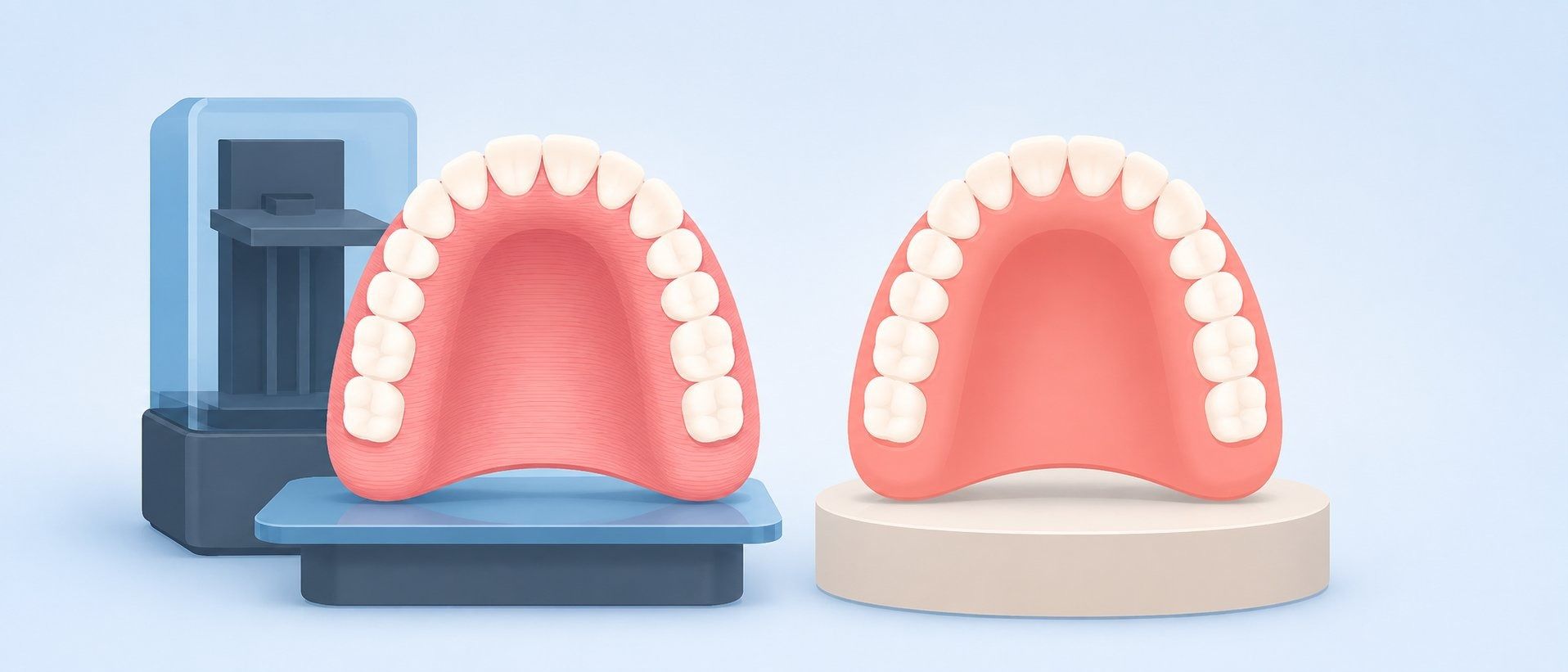

TCS vs. Metal Framework vs. Clear Framework Partials: A Removable Prosthetics Comparison
Three framework families compete for most partial denture cases: TCS flexible (nylon) partials, cast metal (cobalt-chromium) framework partials, and clear (acetal) framework partials. A Kennedy Class I mandibular arch with bilateral distal extensions, for instance, asks for rigid support and proven longevity, while a single bounded space in an esthetics-conscious patient might tolerate a more flexible or tooth-colored design. The framework choice rarely comes down to one feature. It balances rigidity and support, esthetics, durability, reline and repair, tissue response, and hygiene, and the right answer depends on the case in front of you. This guide compares all three across those factors, with a three-way summary table and an FAQ, so you can match material to case and weigh your full range of removable partial denture options before you prescribe.
The Short Version Cast metal (Co-Cr) is the rigid, durable default for definitive partials, complex Kennedy classes, and cases needing precise tooth-borne support and easy adjustment.
TCS flexible (nylon) wins on esthetics and tolerates tissue undercuts and metal allergies, best on shorter spans and interim cases.
Clear (acetal) offers tooth-colored clasping for select esthetic or interim needs, but its low rigidity limits it as a definitive long-span framework.
TCS Flexible (Thermoplastic) Partials
TCS partials are molded from a polyamide, a nylon-based thermoplastic, rather than cast from metal. The material is injected as a single flexible piece, so the denture base and clasps are gingiva-colored and there is no visible metal at the margins. That esthetic profile is the main reason dentists reach for it. TCS flexible partials also adapt well to tissue undercuts that would complicate a rigid framework, and they give you a metal-free option for patients with a nickel or cobalt sensitivity.
Nylon's defining mechanical trait is flexibility. It has high impact resistance and resists fracture through deflection rather than stiffness, which is the opposite of how a cast framework behaves. That same low rigidity is the tradeoff: a flexible base does not control denture movement or transfer load to the abutments and tissues the way a rigid major connector does, which is why nylon is a weaker choice for long spans and distal-extension cases that depend on firm support.
The peer-reviewed literature also flags handling and longevity limits. Polyamide is hygroscopic, so it absorbs water over time and can swell or change dimensionally. The material is also difficult to finish and polish to a smooth surface, and it bonds poorly to conventional repair and reline resins, which makes chairside or lab adjustment harder than with acrylic or metal (Vojdani and Giti, 2015). Manufacturers, including TCS, market their nylon products as rebasable and repairable. Treat that as a manufacturer claim that sits in tension with the published difficulty of relining and repairing polyamide, and set patient expectations accordingly.
Cast Metal Framework Partials (Cobalt-Chromium)
A cast metal partial is built on a cobalt-chromium framework that integrates the rests, major and minor connectors, and clasps into one rigid unit. That single rigid structure is what lets the prosthesis control movement under function and direct occlusal load to the abutment teeth and supporting tissues in a planned way. Cast metal framework partials remain the reference standard for definitive removable partials for exactly that reason.
Rigidity is the headline property, and the gap is not subtle. Cast Co-Cr has an elastic modulus on the order of 200 GPa or more, depending on the build method, which is roughly two orders of magnitude stiffer than acetal or nylon. That stiffness lets clasps and connectors stay slim while still holding their adjusted shape and resisting permanent deformation in service. Metallic materials for these frameworks are specified under ISO 22674, the dental standard for metallic restorative materials, with rigid removable partial denture components generally falling in its higher property classes (Types 4 and 5).
The mechanical data back up the durability story. In one in vitro dataset, cobalt-chromium produced by selective laser melting reached an ultimate tensile strength near 1,066 MPa, a 0.2% yield strength near 695 MPa, and a Young's modulus near 279 GPa, all comfortably above the ISO 22674 minimums for partial denture frameworks (Dimitriadis et al., 2023). Those figures come from an additively manufactured (SLM) sample rather than a traditional casting, and exact modulus values vary by build method and alloy, but the practical point holds across build methods: metal is far stiffer than any tooth-colored resin. Beyond stiffness, Co-Cr frameworks give you precise tooth-borne support, straightforward clasp adjustment, and retrievability, and they hold up across long service lives.
Clear and Acetal Framework Partials
Clear, or tooth-colored, framework partials are most commonly made from acetal resin, also called polyoxymethylene (POM). The framework and clasps are molded in a translucent or tooth-shaded material, so the retentive arms blend with the teeth instead of showing as metal. For patients who object to a visible clasp on a premolar or canine, clear framework partials can be an appealing esthetic compromise.
The catch is rigidity again. Acetal has a low flexural modulus, well below that of cast metal, so a clasp made of acetal cannot generate useful retention at the slim cross-section a metal clasp uses. To reach adequate stiffness and retention, the acetal clasp has to be made thicker and broader than its metal equivalent (Turner, Radford, and Sherriff, 1999). That extra bulk has clinical consequences: bulkier clasps and framework elements can retain more plaque along the gingival margin, and acetal is difficult to adjust intraorally once delivered, since it does not respond to chairside bending the way a metal clasp does. Retentive force from acetal clasps also tends to be lower than from cobalt-chromium (Arda and Arikan, 2005).
Position acetal accordingly. It works as an esthetic clasping option or an interim and transitional appliance, but its low rigidity limits its value as a definitive, long-span framework where rigid support and adjustability matter.
Matching the Framework to the Case
Material selection here is a clinical-judgment call, not a formula, but a few patterns hold up well in practice.
Esthetics-first cases, metal allergy, pronounced tissue undercuts, and shorter spans. A reasonable interim or transitional option. Avoid it for long-span, distal-extension, or heavy-load definitive partials that need rigid support.
The first choice for durable definitive partials: complex Kennedy classes, distal extensions, and any case that benefits from precise tooth-borne support, easy adjustability, and retrievability.
Esthetic clasping where a metal arm would show, or an interim appliance. Limited as a definitive long-span framework because of its low rigidity.
Span length and Kennedy class do most of the sorting. A bounded space with teeth on both sides tolerates a flexible or acetal design more readily than a free-end distal extension, where movement under load punishes a low-rigidity framework. Esthetic demand, allergy history, and the amount of chairside adjustment you expect round out the decision. When two options look close, the more rigid framework usually ages better under function, which is one reason metal stays the default for definitive cases even when a tooth-colored option photographs well on day one.
Once a case has moved past partial coverage toward a complete denture, the conversation shifts again; our look at helping patients see the value in dentures covers that next discussion.
TCS vs. Metal vs. Clear Framework Partials: Side-by-Side
| Factor | TCS Flexible (Nylon) | Cast Metal (Co-Cr) | Clear Framework (Acetal) |
|---|---|---|---|
| Material | Polyamide (nylon) thermoplastic | Cobalt-chromium alloy | Polyoxymethylene (acetal/POM) |
| Rigidity / support | Low; flexible base | High; rigid integrated support | Low to moderate |
| Esthetics | Excellent; no metal clasps | Metal clasps may show | Good; tooth-colored clasps |
| Clasp bulk | Slim and flexible | Slim metal | Bulkier; low modulus needs more cross-section |
| Durability | High impact resistance, low stiffness | Highest; long service life | Moderate |
| Reline / repair | Difficult per literature; vendors claim easier | Established and adjustable | Hard to adjust intraorally |
| Tissue / hygiene | Hygroscopic; finishing limits | Well tolerated, cleanable | Bulk can increase plaque retention |
| Best candidate | Esthetics, allergy, undercuts, short spans | Durable definitive, complex cases | Esthetic clasping, interim |
| Limitations | Long-span and distal-extension cases | Esthetics of metal clasps | Not ideal as a definitive long-span framework |
How Summit-Horizon Fabricates All Three
Summit-Horizon fabricates all three framework families in house: TCS flexible thermoplastic partials, cobalt-chromium metal framework partials, and tooth-colored clear framework partials. Because the full range lives under one roof, the framework decision stays a clinical one about the case rather than a question of which lab can make what. Send us the scan or impression along with the Kennedy class, the span, the abutment situation, and any esthetic or allergy considerations, and our team will recommend a framework and clasp design suited to that specific partial. For borderline cases, we will talk through the rigidity and longevity tradeoffs before fabrication, whether that points toward a rigid cast framework for a demanding distal-extension case or a flexible or acetal design where esthetics lead and the span is forgiving. The aim is a partial that fits, retains, and holds up, chosen on the merits of the case.
Frequently Asked Questions
Which partial denture material is most durable?
Cast cobalt-chromium frameworks are the most rigid and durable of the three, with precise tooth-borne support and a long service life. Flexible nylon resists impact well but is far less rigid, and acetal falls in the middle. For a definitive partial expected to last many years, the cast metal framework is the most predictable choice on durability alone.
Are flexible (nylon) partials a good long-term solution?
They excel for esthetics, metal allergy, and pronounced tissue undercuts on shorter spans, and they make reasonable interim appliances. Their low rigidity and the difficulty of relining or repairing nylon make them less ideal for long-span or distal-extension cases that need firm, rigid support over the long term. Match them to the case rather than treating them as a universal upgrade.
What is a clear framework partial made of?
Clear framework partials are most commonly made of acetal resin, also known as polyoxymethylene, or POM. The material can be molded in tooth-colored or translucent shades, so the clasps blend with the teeth instead of showing as metal. Because acetal has a low flexural modulus, the clasps must be bulkier than metal clasps to retain adequately.
Can flexible partials be relined or repaired?
Peer-reviewed literature describes nylon as difficult to reline, finish, and repair, in part because it bonds poorly to conventional repair resins. Some manufacturers market rebasable or repairable versions of their nylon products. Treat those as manufacturer claims and set patient expectations accordingly, since chairside and lab adjustment are harder than with acrylic or metal.
When is a metal framework partial the better choice?
Choose a cast metal framework for durable definitive restorations, complex Kennedy classes, and any case that needs rigid support, easy adjustability, and retrievability. The integrated cobalt-chromium structure controls denture movement and directs load to the abutments and tissues in a planned way, which is hard to reproduce with a flexible or acetal design.
Which option is most esthetic?
Flexible nylon and clear acetal both avoid visible metal. Nylon blends with the surrounding tissue because the base and clasps are gingiva-colored, while acetal offers tooth-colored clasps that disappear against the teeth. The most esthetic choice depends on whether the visible element in your case is gingiva or tooth, and on the span and support the case requires.
Weighing a framework choice for a specific partial? Tell us the span, the Kennedy class, the esthetic demand, and any allergy history, and we will help you land on the right design. Contact Summit-Horizon to talk through framework selection, or submit a case and we will recommend a TCS flexible, cast metal, or clear acetal partial matched to the situation.
References
Share Post
Search Post
Recent Insights